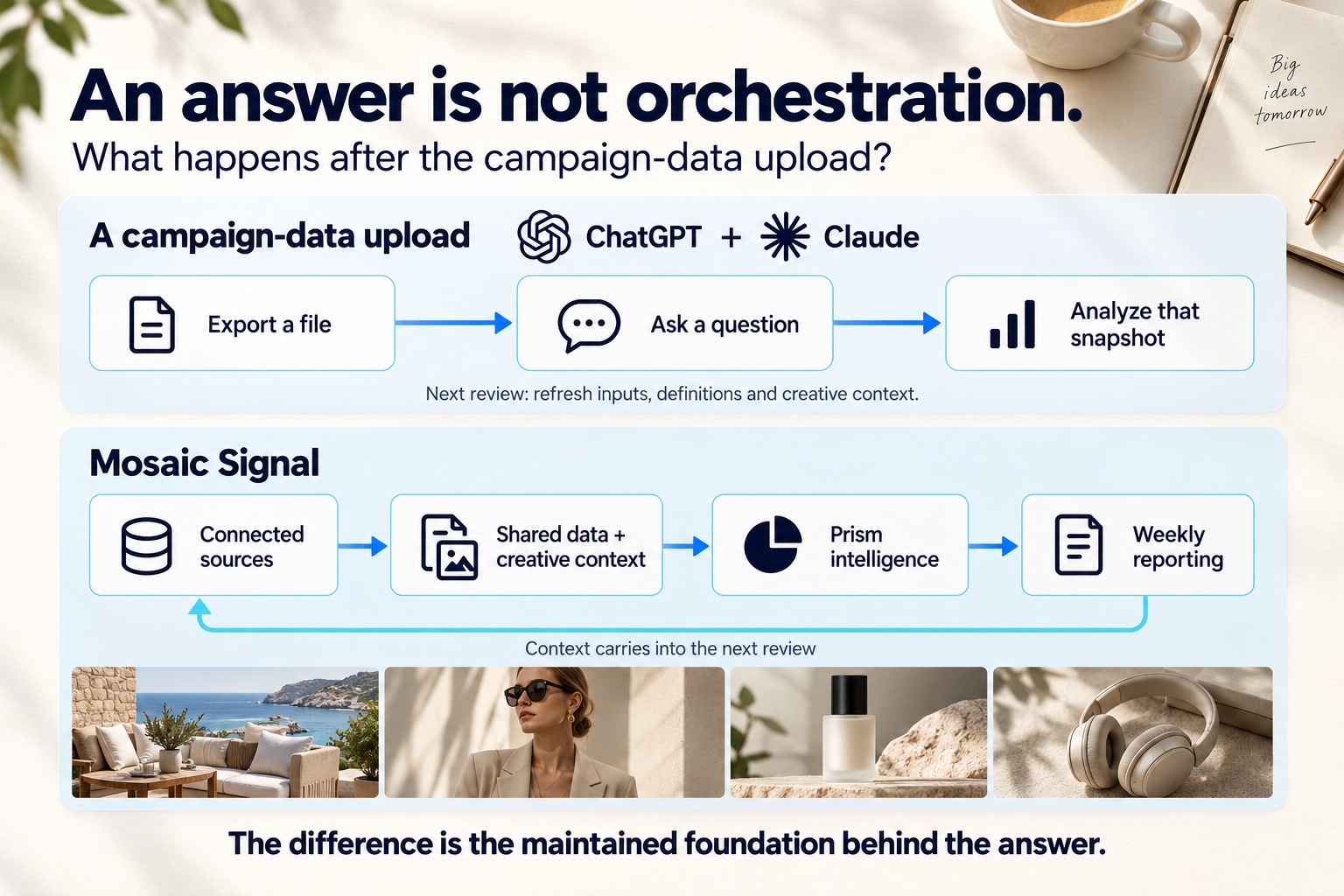
View the comparison diagram full size
What a campaign-data upload does well
Export a campaign report, upload it to ChatGPT or Claude and ask what changed. That can be a useful way to inspect a file, calculate a metric, visualize a trend or draft an explanation. With clear column names, a defined reporting period and the right instructions, general AI assistants can support meaningful marketing analysis.
Both products offer capabilities beyond a single chat, including persistent project context or connected apps, depending on your plan and settings. The comparison here is specifically a downloaded campaign report versus a connected marketing intelligence workflow. It is not a claim that assistants cannot retain context, analyze creative or connect to other systems.
If you have one clean dataset and one focused question, a file upload may be enough. The extra work appears when the same review must bring together several channels, creative assets, business units and changing definitions every week.
- 01ConnectSources, creative and business units
- 02UnderstandDefinitions, patterns and comparison context
- 03ReviewReports, test ideas and team decisions
Why Mosaic adds value to recurring marketing analysis
Mosaic Signal is built to maintain the marketing context behind the conversation. Connected sources feed a shared data and creative warehouse. Campaigns and business units are organized consistently, while the original measurement definitions remain visible. Your team can return to the same foundation for reporting, creative review and the next decision.
That preparation matters. A search conversion and a paid social conversion can use different attribution windows. A website booking event is not necessarily a completed stay or advertising-attributed revenue. A polished summary does not resolve those differences unless the underlying data and definitions are available.
You could build a similar workflow around an assistant, connectors, storage, rules and reporting jobs. Mosaic packages that ongoing marketing work into one platform. Its value is the maintained workflow and marketing-specific context, not a promise that one model always writes a better answer.
| Review need | Downloaded campaign data | Mosaic Signal |
|---|---|---|
| Data freshness | Reflects the export; refresh or reconnect the input for a later review. | Uses the latest completed source refresh at the agreed cadence. |
| Comparable context | Provide or maintain campaign mappings, periods and metric definitions. | Keeps normalized campaign and business-unit context alongside source definitions. |
| Creative evidence | Supply the assets and relevant performance context as well as the spreadsheet. | Prism connects creative choices, scoring and available results in a shared library. |
| Recurring reporting | Arrange the inputs, schedule and distribution around the assistant workflow. | Weekly runs and reporting are included; higher cadence is scoped in Enterprise. |
| Team decisions | Maintain the review history and next-test process around the analysis. | Connects reporting and test ideas; Enterprise adds configurable approval gates. |
A useful answer starts with useful context. A repeatable decision needs that context to stay connected.
Creative intelligence needs the creative, too
A campaign export can show spend, clicks and available outcomes. It does not automatically show what the audience saw: whether the product appeared early, how the message was framed or which visual choice changed between variations. Those details require the actual creative and the right comparison context.
Prism brings that evidence into the review. It examines creative choices and presents Stop, Hold, Click, Convert and Fit scoring dimensions alongside available campaign results. Compare similar ads by business, channel, objective and format, then choose a specific test for your team to review.
An assistant can also inspect supplied images or other supported media. Mosaic’s advantage is keeping the asset, its context and the recurring review connected. A higher Prism score is not proof of causation or a prediction of bookings, revenue or return on spend.
Illustrative case study: the next weekly campaign review
Consider a fictional hotel marketing team reviewing rooms, dining and wellness campaigns across paid search and paid social. The team wants to know whether to change the budget or test a different creative message. This is a workflow example, not a customer result or a measured performance claim.
With downloaded reports, an analyst supplies the exports, aligns the reporting dates, explains each source’s conversion definition and attaches the relevant creative. ChatGPT or Claude can help analyze those inputs. For the following week, someone must maintain the input process and carry forward the decisions and definitions.
With Mosaic, the team starts from connected sources and established business-unit mappings. It checks the latest completed refresh, separates platform-attributed outcomes from website events and reviews comparable creative through Prism. A reporting question becomes a defined test idea instead of a broad instruction to spend more on the apparent winner.
| Stage | What the team reviews | What carries into the next review |
|---|---|---|
| Challenge | Rooms, dining and wellness use different campaign names and outcome definitions. | Shared business-unit mappings and retained source definitions. |
| Analysis | Campaign results and creative are compared within the same channel, objective and format. | The creative asset, its context and the reason for the proposed test. |
| Decision | Test one headline on the same ad, keeping audience, image and budget consistent. | A focused brief and a consistent basis for reviewing the result. |
Keep your assistant. Give it connected marketing context.
You do not have to stop using ChatGPT or Claude to use Mosaic. Model Context Protocol (MCP) lets compatible assistants retrieve supported Mosaic information through authorized, read-only tools. Ask a question in the interface you prefer while Mosaic supplies the connected marketing foundation.
MCP access is available with every Mosaic plan within agreed allowances and your AI provider’s requirements. It does not grant unrestricted access or permission to change campaigns. An exported client-specific knowledge base is a separate Enterprise feature.
Choose the workflow your team actually needs
Use a campaign-data upload when the task is occasional, the inputs are well understood and someone owns the preparation. Consider Mosaic when your team repeatedly needs cross-channel reporting, creative intelligence and consistent context across brands or business units.
Every Mosaic plan includes Prism and weekly runs and reporting within agreed scope. Scale expands planning and competitive monitoring. Enterprise adds search and AI visibility, higher agreed cadence where supported, a downloadable client-specific knowledge base, optional self-learning, configurable approval gates and multi-model orchestration. Learning remains client-specific; customer data is not used to train other customers’ models.
Compare the whole process: preparing inputs, keeping definitions current, reviewing creative and carrying the decision forward. A demo should show those steps using the questions your team already asks. That is the practical test of whether a dedicated marketing intelligence platform adds value for your organization.
Frequently asked questions
Why use Mosaic Signal instead of uploading campaign data to ChatGPT or Claude?
ChatGPT and Claude can analyze campaign exports, create charts and help explain results. Mosaic adds the ongoing marketing foundation: connected sources, consistent campaign and business-unit context, source definitions, Prism creative intelligence and scheduled reporting. A downloaded file captures the data included at export time; Mosaic works from the latest completed refresh and retains context for the next review. Use a file upload for a focused question, and Mosaic when your team needs a repeatable marketing intelligence workflow.
What does Prism add beyond a campaign spreadsheet?
A campaign spreadsheet contains the fields you exported. Prism connects the creative itself, including its opening, message, subject and format, with available performance evidence. It compares similar creative by business, channel, objective and format, explains scoring dimensions and suggests a specific next test. Uploading creative and context to a general AI assistant can also support analysis; Mosaic keeps that work connected to the creative library and recurring reporting. Prism scores are not predictions of future returns.
How do Mosaic’s Claude and ChatGPT MCP connections work?
Mosaic integrates with compatible Claude and ChatGPT experiences through Model Context Protocol (MCP). Connect and authorize access to your Mosaic workspace, then ask your assistant about connected performance data, Prism creative intelligence or reports. Supported Mosaic tools retrieve information within your permissions, using the latest completed data refresh. Access is read-only: the connection does not change campaigns or launch ads. MCP is available with every Mosaic plan within agreed usage allowances and your AI provider’s access requirements. A downloadable knowledge base is not required to use MCP; client-specific knowledge base exports, optional self-learning and configurable approval gates are Enterprise features.
Does Mosaic always use real-time data?
No. Answers reflect the latest completed refresh and the coverage of your connected sources. Business and Scale include weekly runs and weekly reporting. Enterprise can agree a higher cadence where supported. Check the reporting period, refresh status and source definitions before acting on a recommendation.
Sources and further reading
Assistant capabilities depend on your plan and workspace settings. Comparison reviewed October 11, 2026.